

Person zero
and how to become a ‘super’ spreader.

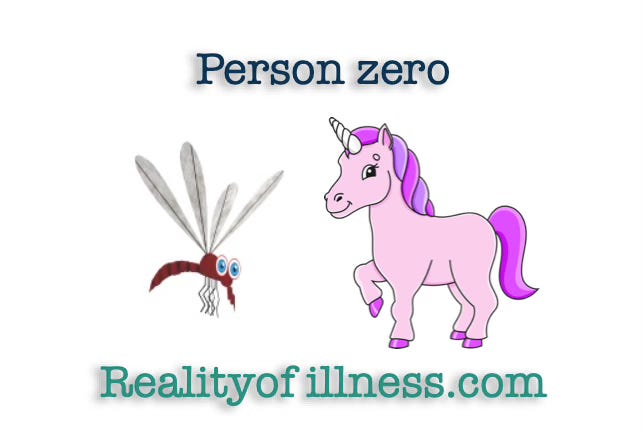
It may be misplaced optimism, but I think many people are starting to see the fundamental flaw in the contagion myth becoming obvious.
With very detailed books like: ‘Can You Catch a Cold’ by Daniel Roytas it should be case-closed, certainly for colds and flu, but people seem unable or unwilling to read this excellent book and then to let go of a belief they have likely held for their whole lives.
Nevertheless I think people have started to realise that if you have to catch something, even as mundane as a cold, off somebody else — how did the first person ever get it?
This is very likely the reason for two new theories that are being aggressively pushed.
First, illnesses which usually come in the shape of a virus of some kind can now supposedly jump into humans from animals. This is obviously a first class excuse for how the first person is supposed to be able to get the illness.
This notion is pushed alongside an equally preposterous idea that someone in a lab takes a virus, something that has never ever been seen yet alone isolated, and sticks new bits onto it in a scary sounding thing called: ‘gain of function’. This process allegedly makes a whole new imaginary virus or variant out of an old imaginary virus.
Laughably, I imagine this being like adding an extra horn onto a unicorn or perhaps changing it from being white to being pink ...something you obviously can’t do unless you have an original unicorn to work on.
Contagion, why so plausible?
It is fairly easy to see how the whole concept of contagion arose when you think about it.
For instance, if you get conjunctivitis in one eye, it can often seem to spread the other eye so why not to someone else as well?
And if you get a toe nail infected with fungus it seems to be able to spread to an adjacent toe or the other foot despite your feet obviously having been subjected to the identical terrain of the original poorly toe nail …which is likely why the fungus took hold anyway. Bring on the foot baths at swimming pools and for verrucas of course.
Where the concept of spread (contagion) came from originally is also possibly very easy to guess from things we see around us in other biology and nature.
For instance, dig-up some bluebells or forget-me-knots, or plant some mint, bamboo or something else quite invasive and suddenly it is everywhere in your garden and probably your neighbour’s garden too. Rhododendrons are not native to the UK but having been introduced they have spread readily into many hitherto wild areas like into woodlands.
Daffodils or poppies equally seem able spread similarly as if by magic.
Spread using vectors
There is also a complimentary concept running alongside contagion which is the concept of a ‘vector’ in other words some kind of spreading mechanism which is also often actually seen in nature to conveniently illustrate its plausibility for alleged viruses.
The simplest example of a vector would be a bird that feeds on a berry which contains seeds. The bird then poops out the seeds somewhere else so the particular berry seed finds a new place to grow into a whole new berry plant. So the bird is the vector for spreading the berry-bearing plant.
Nature quite often hijacks some kind of spreading intermediary in this way.
Bubonic plague was supposedly spread by the bites of infected fleas which used rats and other rodents as a kind of Uber taxi service to move the disease around whole countries or even whole continents. Obviously the same people living in the very same atrocious conditions or being similarly malnourished or just plain scared shitless of being infected had nothing to do with this.
The wind can spread seeds or pollen in plants so it would seem obvious this could equally spread imaginary viruses and other pathogenic microbes. I mean if hay-fever-causing irritants can blow in the wind causing sneezes miles away from the source of the pollen, then why not nasty germs?
However to me, in cases where mosquitoes or ticks are the alleged vectors, the concept falls down since you have to have the thing in the first place in order to be able to spread it. You have to have a ‘person zero’.
Of course the same would have applied to how bubonic plague managed to get into the first flea before it ever jumped aboard its Uber rodent transportation system.
To me, and I am not a scientist, I ask how can a mosquito possibly be responsible for spreading malaria or dengue fever from one person to another when the first diseased person needed to exist to begin the whole process? Again you have to have a ‘person zero’.
Other kinds of spread and vectors
Rumours, ideas, beliefs, even religion can spread very easily so that is also kind of like contagion.
These things can also illustrate the notion of spread using a vector. News spreads using TV, radio or newspapers as a vector and religion usually does the same using some kind of fancy book like a Bible or a Koran helped along by a network of church-type places and clergy-type people.
Memes using the internet as a vector can easily go viral like the ‘Charlie bit me’ video with many similar examples. Even rumours can spread out of control in this way without anyone checking an original source or ‘person zero’.
So the concept of something spreading is obviously something we humans very easily entertain or else we can very easily invent to explain something we don’t understand.
Become an ROI Superspreader
At Reality of Illness we want to use the silly notion of contagion against the perpetrators who use it to scare people about illnesses and viruses.
We are launching an app on July 1st to support our online database.
Using our app, anyone who downloads it will be able to represent themselves by placing a marker on a world map to illustrate how the concept of terrain is actually spreading around the world.
Note: This marker will be as anonymous as you wish and also allows you to attach a short poignant or rebellious message.
We are cheekily calling such champions of the terrain perspective ‘superspeaders’ and we hope you will download the app and join in to show the global support for the more scientifically-based terrain perspective.
Let’s start spreading the truth about health and wellness around the world.
Be sure to get our new app on July 1st