

You’re wrong!

People don’t like being wrong. They especially don’t like being told or shown they are wrong or given definitive proof that proves beyond any question they are wrong because it makes them look stupid.
It shatters formerly held and possibly very strong beliefs but sometimes it dangerously opens up pathways into questioning everything.
For example when people discover they were wrong about germ theory (as I was myself not too long ago) it seems, for a few people, to open up a pathway to then start questioning absolutely everything else they previously thought they knew for sure ...even all the good stuff.
This is quite odd and I don’t know which is worse, realising you were wrong about something or, as a result, starting then to doubt and question absolutely everything.
Note: There is a lot besides germ theory that is pure fantasy BUT NOT EVERYTHING!!!
People seemingly have a strong need to believe in things so it plainly gives them comfort and security. But they often hang onto ‘believing’ against all contrary evidence. Perhaps having to relinquish a wrongly held strong belief when it eventually happens is so unsettling that there is some kind of mental cascade effect that can account for why many other things suddenly need to be questioned.
But I’m only guessing because this hasn’t happened to me.
Evidence
If people always needed some actual, physical, tangible evidence to hold a belief then nobody would believe in God (any of the hundreds of them) because there is no evidence whatsoever. However, a wealth of seemingly reasonable evidence could easily have you totally convinced about the existence of Santa Clause — as many likely were once completely convinced.
So I think you have to discern.
Discerning
‘Discerning’ sounds like choosing what to believe but really it just means thinking critically or finding out more. So discerning should mean you are judging for yourself by evaluating good evidence without having any peer pressure to believe anything in particular. And you should stay objective regardless of how many other people might also believe the same something ...or might believe something else.
It means looking at the solid evidence and if there isn’t sufficient solid evidence for you then being able to feel fine about saying something is unproven to your required level. Unproven is not disbelief and I have a very long personal list of things I consider to be unproven to my satisfaction.
However, if something is very readily, reliably and easily proven with copious evidence in support then you just look stupid if you consider it to be unproven or you believe something contrary. Worse still this contrary stance will lose you respect and credibility and make you look like a cult member.
Cognitive dissonance
Cognitive dissonance means simultaneously keeping opposing views, ideas, beliefs or values so it doesn’t really describe how you can believe something very solid like say ice is just frozen water and at the some time believe in something daft like goblins and fairies?
Earth
I am just astonished that anyone can doubt the Earth is spherical. This is because of the sheer enormity of the absolutely compelling historic, physical, optical, logical, geographical, experimental, mathematical, meteorological, astronomical and scientific evidence.
A surveyor friend of mine Jesse Kozlowski has put together loads of evidence from his personal experience observations and he has absolutely no vested interest in trying to fool anyone or in perpetuating some great big lie.
Just some examples of his evidence are here, here or here and they all show very clearly indeed that the Earth, like virtually everything else in the visible universe is demonstrably and unquestionably spherical.
Note: This kind of stuff is a surveyor’s job for which they use some pretty nifty, very pricey and extremely accurate gadgets such as theodolites. But they also rely on wonderfully simple and reproducible geometry (mathematics and trigonometry) that has been used and proven for thousands of years. You are well advised to rely on what surveyors tell you because they are a tad more believable than the loudmouth know-it-all down the pub or online.
What is also nice about taking the word and accurate calculations of a surveyor is you don’t need fancy spaceships. Just as with the maps surveyors have been making (using triangulation) for hundreds of years and which we have all been using and believing for hundreds of years, they can do all their work from down here on the ground. Although in fairness GPS helps them a lot these days.
Spherical Earth isn’t merely a belief, it is literally as solid as the surveyed and mapped ground beneath your feet and just about as solid as any evidence ever gets. And frankly I don’t care if it conflicts with some aged religious books that were dubiously written with equally dubious motives by nobody that anyone knows the credentials for.
History
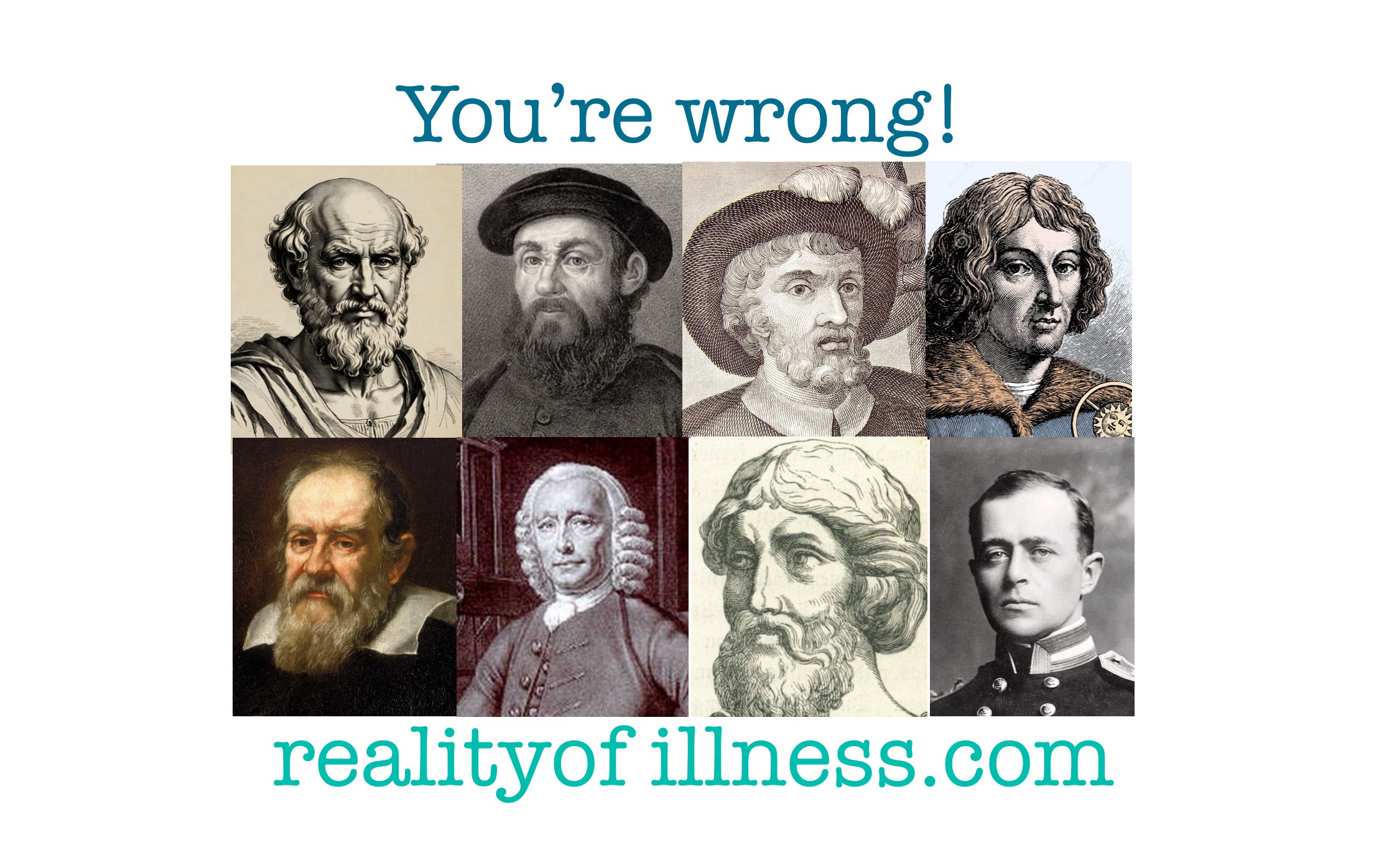
Pythagoras, Aristotle and Eratosthenes didn’t get too much grief 3,000 odd years ago nor did Empedocles and Anaxagora subsequently for their spherical Earth observations and the fairly accurate calculations they made.
However, Nicolaus Copernicus and Galileo Galilei had far more grief. But while Galileo had his books banned and suffered house arrest for upsetting the church, Copernicus fortunately died not long after he published his heliocentric findings.
It took the likes of Ferdinand Magellan and Juan Sebastián Elcano to do some sailing to completely substantiate the proofs with circumnavigation. And I should also mention two other greats like the watchmaker John (Longitude) Harrison and Robert Falcon (Antarctic) Scott who have made big contributions in differening ways to our current ‘world view.’
Compared with today’s flat earth keyboard warriors who have suffered absolutely nothing for pushing their preposterous beliefs, these guys literally put their lives and balls on the line and we owe them huge respect and gratitude for being real men.
Note: Sexist comments are welcomed and will be duly ignored.
To start showing you some evidence here or some proof that flat Earth belief is utterly wrong and just nonsense would be to dignify a ridiculous argument, so please go and do your own research.
Respect
But where does that leave respect? If you respect someone for a particular belief and then they align themselves with some nonsense there are only these possibilities:
They are also right about the nonsense which means you are likely wrong about it — so they deserve your continued respect and your own beliefs need reevaluation.
They hope their credibility in the good thing will somehow influence you into believing the stupid thing — so they deserve no respect at all especially for assuming their credibility in the one area should have any bearing on something else that might be completely unrelated.
Their alignment with the stupid thing is demonstrably wrong — so it has totally lost them your respect and also possibly damaged whatever good work they might have previously done in relation to a good thing.
You remain convinced by the one good thing the person was associated with and just ignore whatever they say about the stupid thing or possibly anything else because to err is human.
You decide to compartmentalise — so effectively you distance yourself such that you do not accidentally become tainted by association with the stupid thing and the person.
Who?
I have come to understand certain people I applaud and respect for their refutation of germ theory also think the Earth might be flat.
I could mention their names but I don’t feel the need to embarrass them and they doubtless wouldn’t be embarrassed anyway.
This has had a profound effect on me with sufficient capacity to derail my Reality of Illness project since it has lost them my respect to such an extent that I have seriously wondered if I am right to continue to promote them, align with them or be seen to endorse them and the good work I consider they do.
I’m sure they don’t care a jot if they have my respect or not. And it would be arrogant of me to say the views of the people I promote must coincide with my own views. But it can matter when you promote a whole group — be it engineers, trade professionals or whatever — because one or two dodgy apples can taint the whole barrel.
I am however continuing with my project and have decided to ignore the noise and allow latitude for the assortment of beliefs people can hold even if those views in my opinion are provably wrong and anti-scientific.
You are advised to consider your own palatability for views you find unpleasant and objectionable which should not be uninfluenced by me. You should have the balls to make up your own mind about the people with these strange views and how much you let it affect you.
Note: Sexist comments are welcomed and will again be duly ignored.
I don't so much like dividing into categories of right and wrong. Who decides? And upon what criteria? Especially when being right is used as a comeuppance. (I'm not at all suggesting that you are doing that.) I guess it's just too absolute for me to use those terms.
And I also think that realizing for instance, that germ theory has never been proven (which was quite a shocking revelation) and then mask wearing, 6 feet distancing , ventilators, and earlier, Kennedy's death, moon landing, Iran Contra, 9/11, are good reasons for questioning everything. Which I do. I hate lies. But that doesn't mean that everything is a lie. Discernment, as you described it, is key.
I hear you on the difficulty there can be when a person you agree with and admire is found to hold views you find repugnant. For example, they support racist views or think sex with minors should be acceptable. Both these views are immoral and cause harm. However, I think what anyone believes about the shape of our realm is not in this category. Whether one thinks the earth is round or some other shape doesn't harm anyone. It isn't a moral issue or one that makes any day-to-day material difference.
The public's continued belief in virus existence is causing massive harm and death every day. It matters what people believe about this. That is not the case with belief that earth is not a spinning globe. And any individual's belief that way ought not to cast doubt on the respectability of their cognition about viruses and germ theory, which for all the prominent voices in the no-virus space is based on detailed research and analysis.
I fear that argument about the shape of earth is being used to divide us, deliberately. Let's not allow that and keep our focus on what matters. Let people think what they will about earth's shape and origin.